
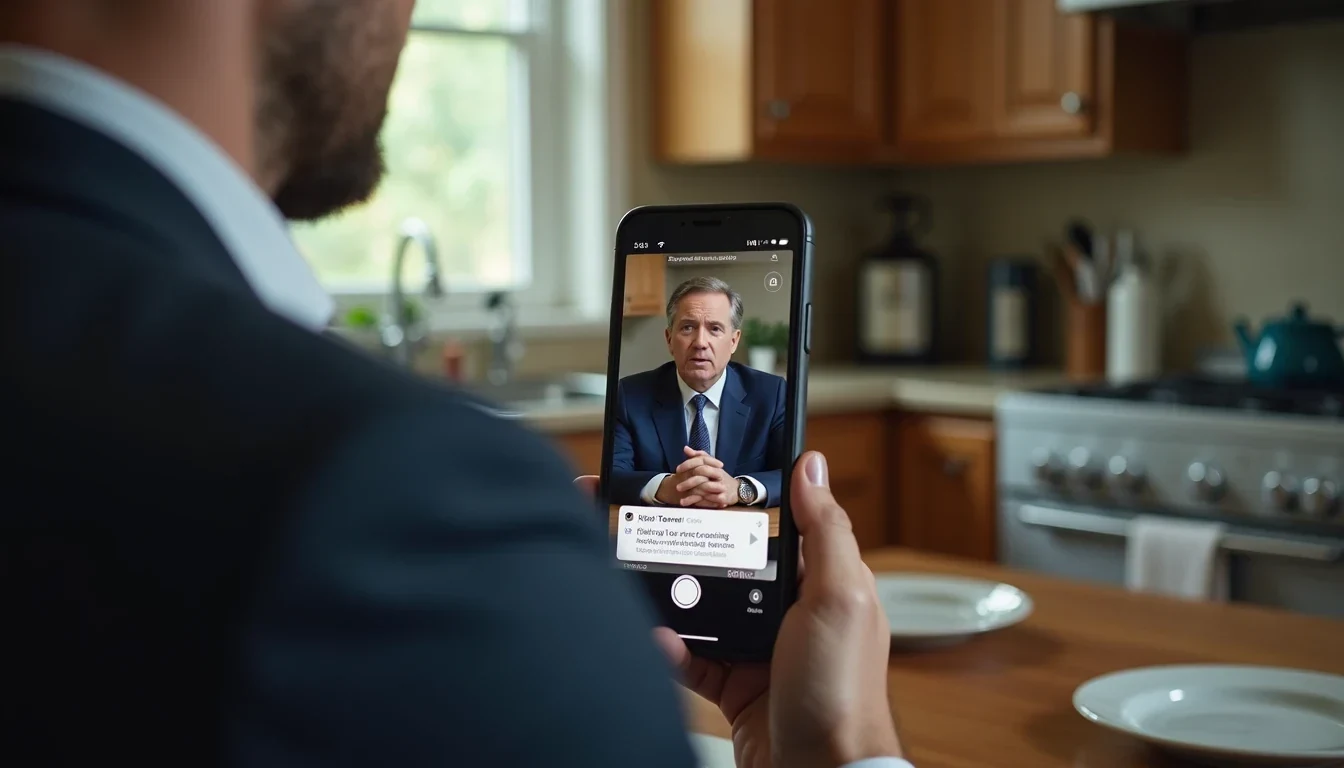
The politician no longer needs the journalist for access, interpretation, or distribution. What once required a press conference, a correspondent, an editor, and a printing press now takes thirty seconds and a thumb on a screen. The gatekeepers have been made optional, like a travel agent in the age of direct booking.
This is not a speculative future. Half of American adults now encounter news primarily through social platforms, according to Pew Research Center data from 2023. The newspaper on the doorstep and the evening bulletin have become residual habits for shrinking demographics. The politician’s tweet, the livestream from a kitchen table, the podcast recorded in a home office: these are the new formats of political communication. They arrive without the friction of editorial review, fact-checking, or adversarial questioning.
The Self-Made Media Entity
Consider the architecture of this shift. When Donald Trump announced policy decisions, staff dismissals, or diplomatic reversals via Twitter during his presidency, he was demonstrating that the tool could replace the institution. The platform gave him simultaneous control of message, distribution, and presentation. No editor could trim his wording. No rival network could interrupt with counter-narrative. No journalist could demand clarification before publication. The message travelled from impulse to public consumption in the time it took to compose a sentence.
After his suspension from mainstream platforms, Trump migrated to Truth Social, a venue designed explicitly to restore this unmediated pipeline. The platform exists to eliminate interference with his preferred framing, not to facilitate debate. This is the politician-as-media model in its purest form: not a user of channels but a proprietor of them.
Steve Bannon constructed something similar with “War Room,” a daily podcast and video operation that functions as a parallel news ecosystem. Trump improvised, but Bannon institutionalised. The show offers commentary, analysis, and narrative construction without the editorial standards or institutional accountability of a newsroom. It selects its own guests, defines its own terms, and answers to no external accuracy framework. The audience receives a complete alternative filtration system, not filtered information.
These are not isolated experiments. Glenn Beck launched TheBlaze in 2011, anticipating by years the migration of political figures into independent media proprietorship. Alexandria Ocasio-Cortez uses Instagram Live to explain policy, respond to events, and cultivate direct constituent relationships, bypassing the interpretive layer of political journalism entirely. The ideological spectrum matters less than the structural pattern: the politician as publisher, broadcaster, and personality rolled into one.
What Disappears in the Bypass
The research on information velocity reveals the stakes. A 2018 MIT study found that false stories on Twitter spread to their first 1,500 recipients six times faster than accurate ones, and were seventy percent more likely to be retweeted. This is a feature of social platform architecture, not a design flaw. Controversy and emotional provocation generate engagement, and engagement generates distribution. Without editorial gatekeeping to slow the spread of unverified claims, the structural advantage lies with the sensational over the accurate.
The removal of journalistic intermediaries eliminates more than fact-checking. It removes the institutional memory that tracks consistency over time, the adversarial posture that challenges evasion, and the professional norm that distinguishes between statement and evidence. When a politician controls the channel, they control which questions reach visibility, which criticisms receive response, and which contexts accompany any given claim. The audience sees only what the politician chooses to illuminate.
Gallup’s 2023 polling on media trust captures the paradox this creates. Trust in mass media has collapsed to thirty-two percent, near historic lows. This institutional distrust does not produce scepticism toward all sources equally. Instead, it fragments along partisan lines, with audiences retreating into channels that confirm existing convictions. The politician’s direct channel benefits from this migration because it offers intimacy, not objectivity, and alignment, not verification. The supporter trusts the politician’s feed because it feels personal, not because it has survived independent scrutiny.
The Architecture of Fragmented Reality
The consequences extend beyond any single false claim or evaded question. When politicians operate as their own media entities, they construct information environments that differ not merely in interpretation but in foundational fact. One constituency receives one description of an event; another receives a contradictory description from a source they equally trust. The shared factual basis that democratic deliberation requires becomes technically unavailable.
Social media platforms accelerate this fragmentation through micro-targeting capabilities that allow politicians to deliver different messages to different demographic segments without broader public awareness. A promise made to one group need never reach another. A framing tested for one region can be abandoned elsewhere. The public sphere, once theoretically unified by common exposure to major news outlets, dissolves into segmented streams that rarely intersect.
The politician’s own channel also collapses the temporal advantage that journalism once held. The ability to respond instantly to breaking events means controlling the initial narrative before any reporter has completed verification. First impressions solidify; corrections arrive too late to displace them. The speed that digital platforms offer is not neutral: it systematically advantages the actor who can speak first over the actor who can speak accurately.
The Accountability Vacuum
It remains unclear whether any institutional response can restore scrutiny without reconstituting the gatekeeping power that direct communication was meant to dissolve. Fact-checking operations, platform content policies, and media literacy initiatives all operate at a structural disadvantage. They respond after the fact to messages that have already reached their audience. They lack the distribution power of the original channel. They carry, for the politician’s supporters, the taint of the very institutionalism that direct communication was designed to bypass.
The politician-as-media model has not eliminated journalism. It has marginalised it for significant portions of the electorate, reducing it to a counter-narrative that partisans can dismiss by source rather than engage by substance. The independent scrutiny that once operated as a precondition for mass political communication now operates, where it operates at all, as a specialist service for the already convinced.
This shift produces a fundamental alteration in democratic dynamics. It creates a structural asymmetry between those who control their own channels and those who attempt to scrutinise them. The politician speaks directly to millions. The journalist speaks to a diminished and polarised audience, often through intermediaries the politician’s supporters do not trust. The conversation that democracy requires becomes, increasingly, a series of parallel monologues that never meet.