
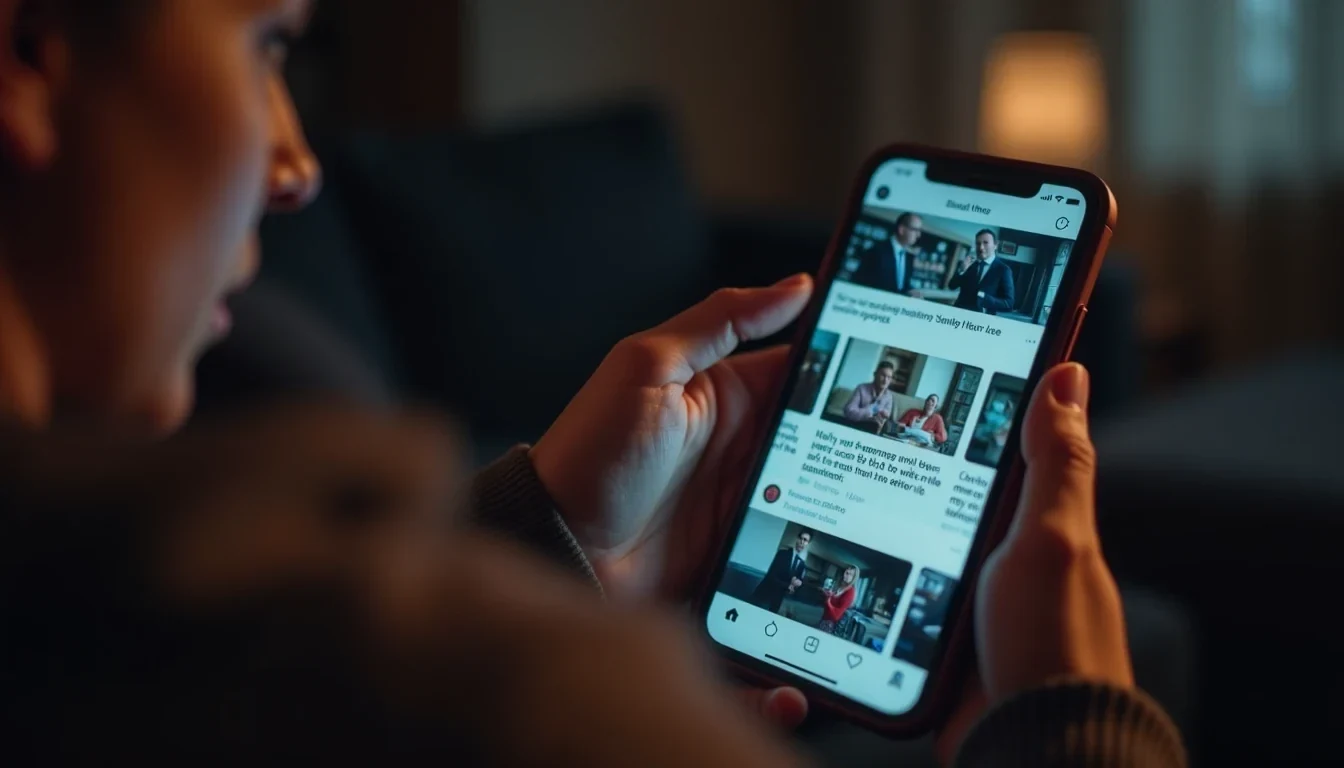
The 2026 Digital News Report arrived with a quiet milestone that should have been louder. Across 48 markets, 54 percent of respondents now encounter news through social media and video networks, while 51 percent still reach for news organisations’ own websites and apps. The gap is narrow, but the direction is clear. For the first time, the incidental path to information has overtaken the intentional one, and this reversal changes what it means to hold a political view.
This is not a story about screen time or attention spans. It is about how a worldview gets assembled when no one is deliberately building it.
The Architecture of Accidental Belief
Consider what happens when news finds you rather than the reverse. A clip surfaces on TikTok or Instagram Reels, stripped of the article that surrounded it, the headline that framed it, the paragraph that qualified it. A creator monologue delivers a verdict on a policy you have not read. A meme compresses a trade negotiation or a military escalation into an emotional payload designed for shareability. Each piece arrives without the user’s prior consent to the topic, without the act of seeking that once characterised even casual news consumption.
The Digital News Report’s figures describe a population that no longer goes to information but is instead gone to by it. The difference is not merely logistical. Active news-seeking, however imperfect, carries with it a minimal structure of deliberation: the recognition of ignorance, the selection of a source, the encounter with a full argument. Passive discovery dissolves that structure. The user is not choosing what to know but responding to what the feed presents. The feed’s logic is not journalistic but algorithmic, optimised for engagement rather than understanding.
Short-form video compounds this. Complex events must fit formats measured in seconds, so context collapses. Historical background, policy nuance, and the full spectrum of stakeholder positions become friction that the format eliminates. A 2023 Pew Research Center finding noted that 43 percent of TikTok users regularly get news on the platform, a figure that predates the current threshold-crossing captured in the 2026 report. The trend has been visible; the tipping point has now arrived.
The Creator as Unacknowledged Editor
Traditional news organisations, for all their flaws, operate with transparent editorial processes. Corrections policies, bylines, mastheads, and the separation of reporting and opinion create at least the possibility of accountability and the framework for critique. The creator economy that now intermediates political information operates under no such conventions.
An influencer delivering political commentary on YouTube or TikTok blends factual assertion, personal narrative, entertainment value, and monetisation incentive into a single product. The viewer often cannot distinguish where reporting ends and performance begins because no boundary is marked. The creator’s business model rewards intensity of connection, not accuracy of information. The most successful political creators do not complicate their audience’s understanding; they confirm and intensify what their audience already feels.
This is not a condemnation of individual creators, many of whom operate with genuine intent. It is an observation about structural incentives. When the route to news runs through personalities rather than institutions, the personality becomes the frame, and the frame becomes invisible. Users believe they are receiving information when they are receiving relationship, attachment to a voice, a style, a posture of knowingness that substitutes for the harder work of verification.
What the Feed Leaves Out
The algorithmic curation that determines what appears in any given feed does not merely select content; it selects for emotional response. Content that provokes strong reaction—outrage, vindication, contempt, solidarity—travels further than content that merely informs. The result is a political environment where the most widely circulated material is often the most polarising. The middle ranges of complexity, the policy details that do not reduce to slogan, and the developments that complicate rather than confirm a narrative simply do not propagate.
The 2026 report’s finding of 54 percent social discovery against 51 percent direct news access points to a public sphere increasingly divided not merely by opinion but by epistemic method. Different groups do not just disagree on conclusions; they arrive at beliefs through incompatible pathways. One group engages deliberately with structured reporting, while the other relies on the accumulated weight of incidental, algorithmically amplified fragments. The decline of a shared method precedes and enables the decline of shared reality.
Institutional trust erodes in this environment not because institutions have become less trustworthy but because the very category of institution becomes suspect. The creator who positions themselves as authentic, unfiltered, and outside the system gains credibility precisely by rejecting the markers of institutional process. Verification, balance, and the slow accumulation of evidence read as symptoms of a rigged game rather than virtues. The feed rewards those who promise to see through the conspiracy, and in doing so constructs a new conspiracy of its own: the belief that all structured knowledge is merely power disguised.
The Worldview No One Chose
A political understanding assembled from incidental exposure carries specific characteristics. It tends toward fragmentation rather than coherence, a collection of intense reactions to disconnected events rather than a structured grasp of how systems function. It privileges the recent and the visible over the gradual and the systemic. It conflates frequency of encounter with importance, so whatever the algorithm surfaces repeatedly comes to feel like what matters most.
Most significantly, it produces the illusion of self-direction in the absence of self-determination. The user believes they have arrived at their views through independent reflection because no single external authority imposed them. Yet the views were shaped by a thousand invisible choices made by platform systems optimising for metrics the user never selected. The politics are not chosen; they are recommended. The recommendation engine is not designed to produce informed citizens but engaged users.
The 2026 Digital News Report documents a structural shift that has already occurred. The question it raises is whether individuals and institutions can still construct spaces for deliberate engagement, or whether the incidental will continue its advance until the very concept of seeking news—of wanting to know something before the feed decides you should—becomes a practice as marginal as subscribing to a physical newspaper already is. The numbers suggest we are closer to that point than many who still consider themselves well-informed have recognised.